How long does creatine take to work?
By Creatine Today · 4 scientific sources · Editorial policy
Creatine doesn't switch on the day you start. It works once your muscle reserves are full — about a week if you do a loading phase of 20 g a day, or 3 to 4 weeks if you take a steady 3 to 5 g a day. The destination is the same; only the speed differs.
The question "how long does creatine take to work" really means "how long until my muscles are saturated." Creatine produces its effects by raising the amount of phosphocreatine stored in your muscle cells, which gives you a bigger reservoir of fast energy for short, intense efforts. On a normal diet that supplies 1 to 2 g of creatine a day, muscle reserves sit at about 60 to 80 percent of maximum capacity (Kreider 2017). Filling the rest of the tank is the part that takes time.
So the timeline depends almost entirely on one choice: do you load, or do you take a standard daily dose and wait?
The timeline, with and without loading
There are two well-studied routes to a full tank, and they're laid out plainly in the research. The ISSN position stand describes the fast route as 5 g of creatine monohydrate four times a day for 5 to 7 days, and the slower route as 3 g a day for 28 days, which produces a more gradual increase in muscle creatine (Kreider 2017). Both arrive at the same place (Hultman 1996).
| Approach | Daily dose | Time to saturation |
|---|---|---|
| With loading | ~20 g (4 × 5 g) | About 5 to 7 days |
| Without loading | 3 to 5 g | About 3 to 4 weeks |
The numbers behind this come from a classic experiment. In Hultman and colleagues' 1996 study, muscle total creatine rose by about 20 percent after 6 days of 20 g a day. A similar 20 percent rise happened more gradually over 28 days at 3 g a day (Hultman 1996). Same increase, different pace. The ISSN stand puts the overall magnitude of muscle creatine and phosphocreatine increase from supplementation at roughly 20 to 40 percent (Kreider 2017).
If you want the short version: loading gets you there in about a week, a standard dose in about a month, and there's no third option that's meaningfully faster.
What "working" actually means
"Working" is the point where your elevated muscle reserves start translating into something you can feel or measure — better output on heavy or repeated efforts, a bit more in the tank on the last set, faster recovery between bouts. The ISSN position stand notes that high-intensity and repetitive exercise performance is generally increased by 10 to 20 percent after creatine loading, and that a slower protocol may have less effect on performance and training adaptations until creatine reserves are fully saturated (Kreider 2017).
That last clause is the whole point of this page. The benefit is downstream of saturation. You don't get a 10 to 20 percent performance bump on day one because your reserves aren't elevated yet on day one.
A useful way to think about it: creatine is a reservoir, not a stimulant. Caffeine works in 30 minutes because it acts directly. Creatine works in days to weeks because it has to accumulate first.
Why day one usually feels like nothing (or like water)
Plenty of people report feeling "something" on the first day or two. Most of the time, that something is water. Creatine pulls fluid into muscle cells, and that shift can start quickly, especially on a loading dose. Water retention in the first several days is the most commonly reported effect of creatine, and a loading week typically adds 1 to 3 kg of body mass, mostly water (Antonio 2021). You might look slightly fuller or notice the scale move within the first week.
That water movement is real, but it isn't the strength effect. The performance benefits ride on saturated reserves, which haven't built up yet that early. So if your first few days feel underwhelming, that's normal and expected — not a sign the creatine isn't working.
Why daily consistency matters more than timing
Because creatine works by keeping your muscle reserves topped off over weeks and months, the single most important habit is taking it every day. Not before workouts specifically, not only on training days — every day, including rest days.
One missed day won't drain your tank. But the direction your reserves drift depends on whether you keep taking it. Hultman's data showed that after people stopped supplementing, muscle creatine drifted back to the pre-supplementation level over roughly the following month (Hultman 1996); the ISSN puts the usual return to baseline at 4 to 6 weeks (Kreider 2017). Saturation is a balance: daily intake keeps it high, stopping lets it fall. Consistency is what makes the whole thing work, which is exactly why a simple daily habit beats clever timing. A 2025 ISSN review of timing studies came to the same conclusion: pre- and post-workout creatine worked about equally well, and consistent intake is likely the most important variable (Antonio 2025).
When to expect strength and performance changes
Put the pieces together and a realistic expectation looks like this:
- Days 1 to 7 (loading) or weeks 1 to 4 (no loading): reserves are filling. You may notice water weight and a fuller look. Don't expect strength changes yet.
- Once saturated (about week 1 with loading, week 3 to 4 without): this is when the performance benefits become available — more reps on hard sets, better repeat-sprint or repeat-effort output, slightly faster recovery between bouts (Kreider 2017).
- Weeks beyond saturation: the strength and muscle changes people associate with creatine are really creatine plus consistent training over time. Give it a few weeks of saturated reserves combined with actual lifting before you judge results.
In other words, the supplement is "working" within a week to a month, but the visible payoff is a training effect that compounds after that. If you stop after two underwhelming weeks of an unloaded protocol — right before saturation — you quit just before it starts doing anything.
See your saturation instead of guessing
The hardest part of all this is that saturation is invisible. You can't feel the tank filling, which makes the first few weeks feel like a leap of faith. That's exactly the gap Creatine Today is built to close.
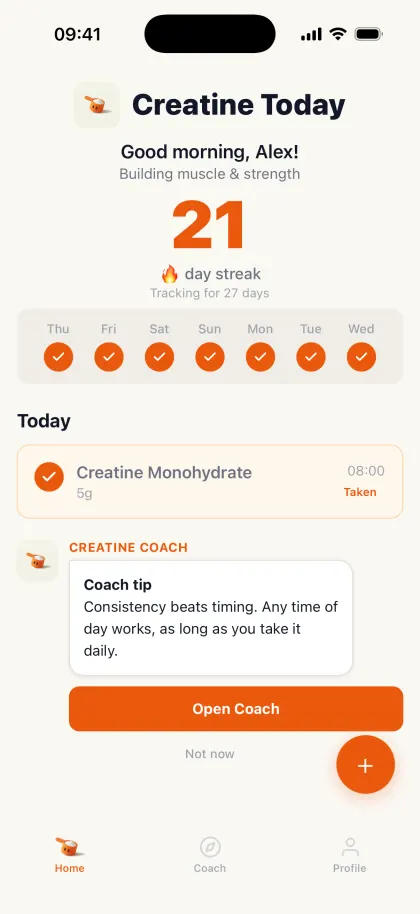
The app estimates your muscle saturation from the days you log, then shows it as a curve that climbs toward full over your first weeks. Instead of wondering whether it's "working yet," you can watch the line approach saturation and see exactly where you are on the timeline this page describes.
Creatine Today turns the saturation timeline into a progress bar you can actually see, and reminds you every day so your reserves stay topped off. The waiting period feels a lot shorter when you can watch the curve climb.
The bottom line
Creatine takes about a week to work if you load with 20 g a day, or about 3 to 4 weeks if you take a steady 3 to 5 g a day. Both routes reach the same saturated endpoint — loading just gets you there faster. The benefits arrive after saturation, not on day one, and they stay only as long as you keep taking it daily.
If you're deciding whether to speed things up, read the loading phase guide. If you just want the simplest sustainable approach, 3 to 5 g a day, every day, gets you there in under a month — no math required.
References
- Kreider RB, Kalman DS, Antonio J, et al. (2017). International Society of Sports Nutrition position stand: safety and efficacy of creatine supplementation in exercise, sport, and medicine. Journal of the International Society of Sports Nutrition, 14:18. doi:10.1186/s12970-017-0173-z · PubMed
- Hultman E, Söderlund K, Timmons JA, Cederblad G, Greenhaff PL (1996). Muscle creatine loading in men. Journal of Applied Physiology, 81(1):232–237. doi:10.1152/jappl.1996.81.1.232 · PubMed
- Antonio J, Candow DG, Forbes SC, et al. (2021). Common questions and misconceptions about creatine supplementation: what does the scientific evidence really show? Journal of the International Society of Sports Nutrition, 18(1):13. doi:10.1186/s12970-021-00412-w · PubMed
- Antonio J, Brown AF, Candow DG, et al. (2025). Part II. Common questions and misconceptions about creatine supplementation: what does the scientific evidence really show? Journal of the International Society of Sports Nutrition, 22(1):2441760. doi:10.1080/15502783.2024.2441760 · PubMed