Should you take creatine on rest days?
By Creatine Today · 3 scientific sources · Editorial policy
Yes, take it. The whole reason creatine works is that your muscles stay saturated, and saturation doesn't take a day off because you did. A rest day is just a normal creatine day with no workout attached.
This is one of the most common creatine questions, and it usually comes from the same place: people assume creatine is like a pre-workout, something you take to fuel a specific session. If that were true, skipping it on a day you don't train would make sense. But that's not how creatine works.
Creatine is a storage supplement, not a stimulant. The benefit comes from how full your muscle creatine reserves are, built up over weeks of consistent intake. On a rest day, those reserves are still working, still being used, and still need topping up. So yes — take it.
Why creatine is a daily thing, not a workout thing
Creatine improves performance by raising the amount of creatine (and phosphocreatine) stored inside your muscle cells. The 2017 International Society of Sports Nutrition position stand describes exactly this: creatine supplementation works by increasing intramuscular creatine concentrations, a daily 3 g dose raises them gradually over about 28 days, and once reserves are full they can generally be maintained with 3 to 5 g a day (Kreider 2017).
Notice what's missing from that description: any mention of timing a dose around a workout. A 2025 ISSN review of timing studies found pre- and post-workout creatine about equally effective and named consistent intake as likely the most important variable (Antonio 2025). The effect lives in the muscle, where the creatine is stored, not in the moment you swallow it. Once your reserves are full, they stay full as long as you keep feeding them daily. Stop feeding them — even just on the days you don't train — and they start to empty.
What happens if you skip rest days
If you only take creatine on training days, you're dosing inconsistently, and inconsistent dosing produces inconsistent saturation. The clearest evidence for how creatine reserves behave when you stop topping them up comes from Hultman and colleagues in 1996. After subjects raised their muscle creatine and then stopped supplementing, total creatine concentration gradually declined, and about 30 days after they stopped, it was no different from where it started. In the same study, 2 g a day was enough to keep the raised level for 30 days (Hultman 1996).
Rest days aren't a full stop — you're still dosing on training days — but the principle holds. Every day you skip, your reserves drift a little lower. Stack up enough skipped days and you're carrying lower saturation than you think, quietly leaving a chunk of the benefit on the table.
Think of muscle creatine like a topped-up tank, not a tank you refill right before each drive. You keep it full by adding a little every day. Skipping the days you don't drive just means the level slowly drops.
How much to take on a rest day
The same amount as any other day. Maintenance studies used 3 to 5 g a day (Kreider 2017), and none used a reduced "off-day" dose. The maintenance dose is about keeping reserves topped up, and that need doesn't change based on whether you trained. If you want the full picture, see our guide on how much creatine to take per day.
When to take it on a rest day
Anytime. On training days, people often anchor creatine to their workout, so a rest day removes that cue and creates the gap where doses get missed. The fix is to anchor it to something that happens every day regardless of training — your morning coffee, breakfast, or simply the same clock time you'd use anyway. Studies comparing different times have not shown that the timing matters much over the long term (Antonio 2025), so pick whatever you'll actually remember. We cover this in more detail in the best time to take creatine.
What if you forget on a rest day
One missed day won't undo weeks of saturation: after stopping completely, reserves took about a month to fall back to baseline (Hultman 1996). Take it when you remember, or just resume the next day. The thing that erodes your reserves is the slow accumulation of skipped days, not a single lapse. So don't treat a forgotten dose as a reason to give up — treat it as a single miss and get back on track tomorrow.
The habit angle: keeping the streak alive
Here's the honest truth about creatine. The dose is trivial. The science is settled. The only thing that actually determines whether it works for you is whether you keep taking it — every day, including the rest days, including the lazy Sundays, including the weeks you don't feel like it.
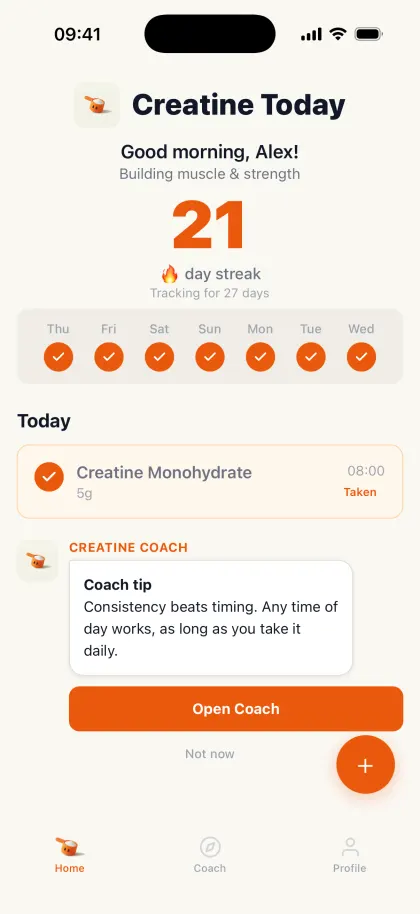
That's exactly where most people fail, and rest days are a big part of why. The day off from training quietly becomes a day off from the supplement, and a few of those a week is enough to keep your saturation lower than it should be. We built Creatine Today around this single behavior: one daily reminder at the time you choose, and a visible streak so skipping a day — training or not — actually costs you something. Keep the streak alive and your muscles stay saturated. That's the whole game.
References
- Kreider RB, Kalman DS, Antonio J, et al. (2017). International Society of Sports Nutrition position stand: safety and efficacy of creatine supplementation in exercise, sport, and medicine. Journal of the International Society of Sports Nutrition, 14:18. doi:10.1186/s12970-017-0173-z · PubMed
- Hultman E, Söderlund K, Timmons JA, Cederblad G, Greenhaff PL (1996). Muscle creatine loading in men. Journal of Applied Physiology, 81(1):232–237. doi:10.1152/jappl.1996.81.1.232 · PubMed
- Antonio J, Brown AF, Candow DG, et al. (2025). Part II. Common questions and misconceptions about creatine supplementation: what does the scientific evidence really show? Journal of the International Society of Sports Nutrition, 22(1):2441760. doi:10.1080/15502783.2024.2441760 · PubMed